The Biological System
Part 01 — Introduction
A clinical map
Six biological systems
In chronic pain, the problem usually lies not within a single part, but in the relationships between parts. Pain is maintained not by one isolated point of damage, but by the way several systems slip out of balance together and become stuck there. This is what the DNA of our system means when it describes pain as multi-system dysregulation.
The Six Biological Systems are a map that shows us where to look. They are not six separate compartments; they overlap and communicate with one another constantly.
The map does not ask us to fix all six. In each patient, usually only one or two systems are truly “driving” the pain at that moment. Our task is to find them.
Part 02 — The Six Biological Systems
01 — Neural regulation
The set-point of the nervous system itself: its level of sensitisation, the balance between sympathetic and parasympathetic activity, the vagus nerve and the sleep–wake axis. This is the system most often involved in chronic pain.
- Pain neuroscience
- Autonomic nervous system
- Vagus nerve
- Sleep & the glymphatic system
- Neural recovery
02 — Biomechanics and movement
How the body bears load, moves and distributes force — where a restriction in a distant region can shift load onto the very place that hurts.
- Functional anatomy
- Biomechanics
- Motor control
- The Chain
- Regional interdependence
03 — Fascia, interstitial fluid and lymphatics
Continuous connective tissue, the interstitium, the lymphatic system and old scars can quietly contribute to pain.
- Fascia
- Interstitium
- Lymphatics
- Scars
04 — Metabolic and visceral health
Whole-body factors that affect how well tissues and the nervous system can recover. This is often the most overlooked system.
- Gut–brain axis
- Liver & metabolism
- Chronic inflammation
- Glucose & hormones
- Nutrition
05 — Biological memory
Pain memory and the protective responses the body has learned can keep pain in place long after tissues have healed.
- Pain memory
- Learned protective responses
- Consolidation & extinction of pain memory
A clinical concept within our system — not a diagnosis.
06 — Emotional and social health
Stress, fear, beliefs about pain and life circumstances can shape both the experience of pain and the capacity to recover.
- Stress
- Fear
- Beliefs
- Movement avoidance
- The person behind the pain
This does not mean “the pain is psychological”. It simply reflects that emotion and the nervous system are always one.
Part 03 — The Central Hub
Where systems meet
Diaphragm, deep core and pressure regulation
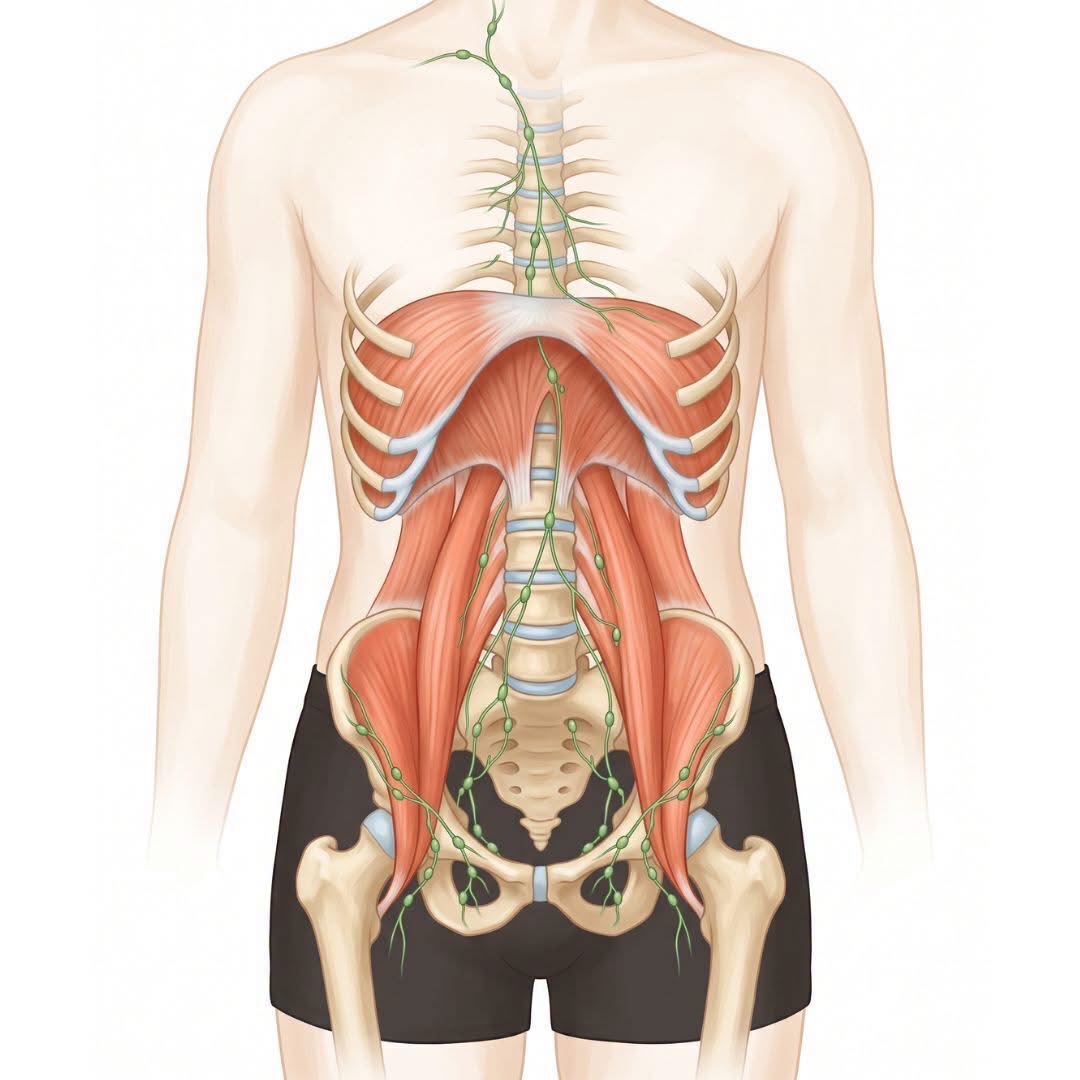
The body does not work as six separate systems. Where breathing, the autonomic nervous system, motor control, fascia and the pelvic floor intersect, we find the diaphragm, the deep core and the body’s ability to regulate pressure within the trunk.
This is not a seventh system. It is a central point of connection.
The diaphragm — a forgotten regulatory organ
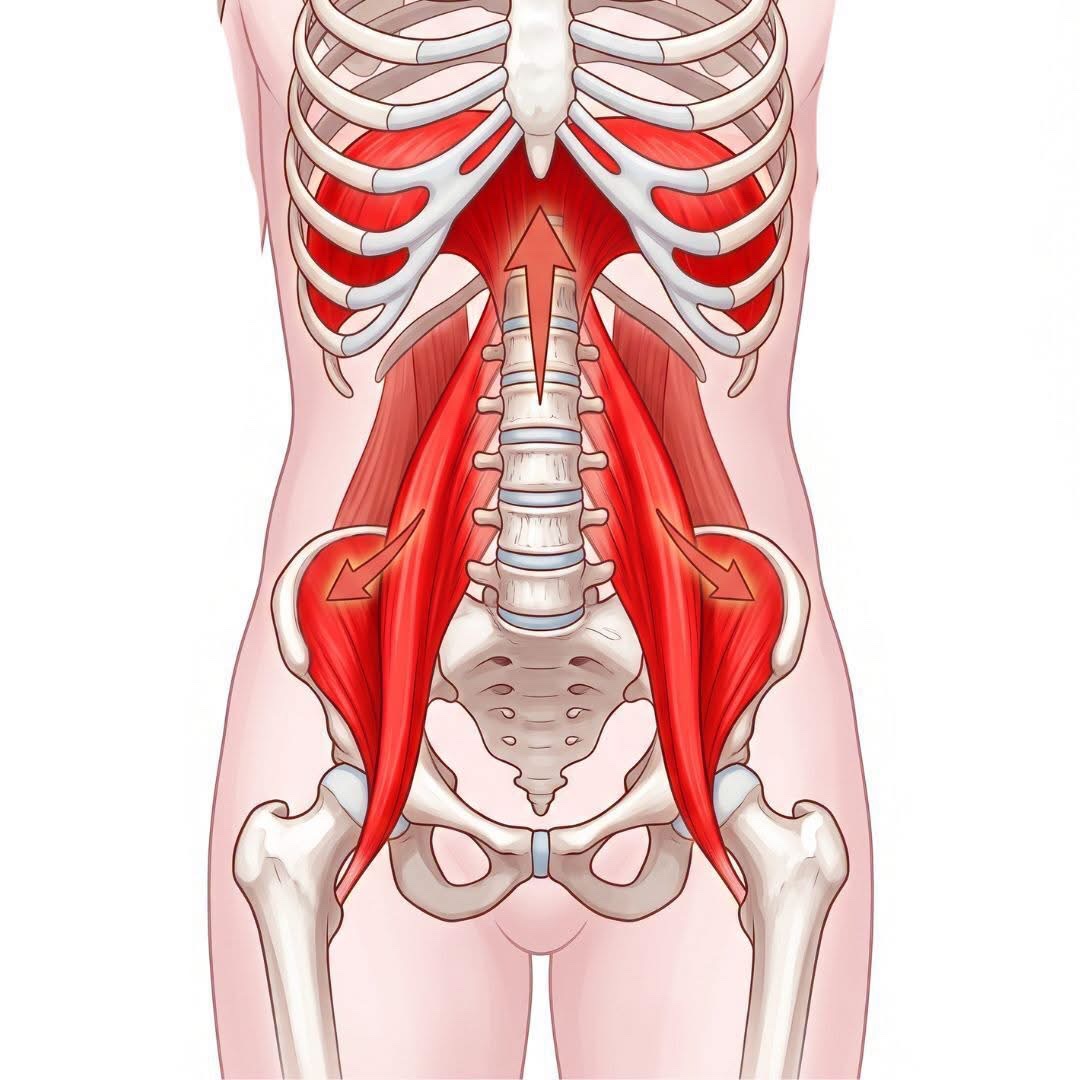
The primary muscle of breathing — and much more. Every breath changes the pressure between the chest and the abdomen, and the diaphragm works with the abdominal wall and pelvic floor to control the trunk as we breathe, move and carry load.
The deep core system
Not a single muscle, and not just the abdominals, but the coordinated work of the diaphragm, deep abdominal wall, multifidus, pelvic floor and nervous system. A good core is not braced all the time — it stabilises when needed, moves when needed and adapts as load changes.
Intra-abdominal pressure and spinal stability
We don’t only ask “Is the core strong?” We look at whether breathing coordinates with movement, how pressure is built and released — and whether the patient is holding their breath or bracing to protect the painful area.
The diaphragm–vagus–pelvic floor axis
BREATHING ↔ NEURAL REGULATION ↔ PRESSURE ↔ CORE ↔ PELVIC FLOOR
Breathing creates a rhythm of movement and pressure from the chest down to the pelvis, while also interacting with the autonomic nervous system — in which the vagus nerve plays an important role. This is a model to support clinical reasoning; it does not mean that a problem in one component always originates in, or can be resolved through, another.
Breathing in pain rehabilitation
Breathing is both automatic and consciously adjustable — and a slow exhale is one of the most accessible ways to reach the vagus nerve. A dysfunctional breathing pattern can itself be the driver of pain.
But breathing is not a universal treatment for every kind of pain. It becomes part of the treatment plan only when it has been shown to matter for that particular patient.
Part 04 — An Important Distinction
Many findings, few drivers
(Finding ≠ Driver)
A driver is the factor maintaining pain right now — not necessarily the original cause, and very often not located where it hurts.
A little degeneration, a tight muscle, a less-than-ideal posture, poor sleep, long-term stress — all of these may be real. But not every finding is steering the pain. They are present, but they are not driving.
That is why a driver is always a hypothesis to be tested — by the body’s real response, not by the clinician’s certainty.
Part 05 — From Map to Clinical Decision
- SAFETY FIRSTRule out red flags, identify the pain mechanism
- SIX BIOLOGICAL SYSTEMSLook widely: which system is driving?
- CENTRAL HUBSee the connections
- DRIVERWhat is keeping the pain here, right now?
- PRIORITISEChoose which driver to address first
- INTERVENETargeted treatment
- TEST & RETESTVerify what has really changed
- ADAPTContinue · Adjust · Change direction
Part 06 — Six Systems · One Hub · One Person
One person may, at the same time, sleep poorly, breathe shallowly, tolerate less load, brace when moving and fear that movement will cause further harm. These factors feed one another.
But because the systems are connected, calming the system that is driving often brings the others along with it. The goal is not to find as many abnormalities as possible, but to find the right starting point — and after every intervention, to return to the body and ask: what has really changed?
Six systems are the map. The person is the territory.